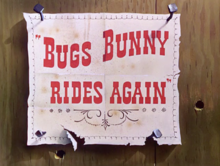
Warner Brothers Bugs Bunny Rides Again Cel
| Bugs Bunny Rides Again | |
|---|---|
 | |
| Directed past | I. Freleng |
| Story by | Tedd Pierce Michael Maltese |
| Produced by | Edward Selzer |
| Starring | Mel Blanc |
| Narrated by | Robert C. Bruce |
| Music past | Carl Stalling |
| Blitheness by | Gerry Chiniquy Manuel Perez Ken Champin Virgil Ross |
| Layouts by | Hawley Pratt |
| Backgrounds by | Paul Julian |
| Color procedure | Technicolor |
| Production | Warner Bros. Cartoons |
| Distributed by | Warner Bros. Pictures The Vitaphone Corporation |
| Release date | June 12, 1948 (1948-06-12) |
| Running time | 7:11 |
| Linguistic communication | English |
Bugs Bunny Rides Once again is a 1948 Warner Bros. Merrie Melodies brusk directed by Friz Freleng, and written past Tedd Pierce and Michael Maltese.[1] The short was released on June 12, 1948, and stars Bugs Bunny and Yosemite Sam.[two]
The brusk is both a Western and a parody of the genre's conventions.[3]
Voice characterizations are performed by Mel Blanc. It is the 3rd cartoon to pair Bugs and Yosemite Sam, after Hare Trigger (1945) and Buccaneer Bunny (1948). The championship is a typical Western reference, as in "The Lone Ranger rides over again", and besides suggests a reference to the Jack Benny comedy, Buck Benny Rides Again (1940).[4]
Plot [edit]
Underscored past a high-energy version of "Cheyenne", a constant hail of bullets flies around the Western town of Rising Gorge. A stream of them sail one way along the main street; a traffic lite (an Acme Regulator, in keeping with Looney Tunes tradition) turns red and those bullets hover in mid-air while another torrent of them shoot by on the cross street, though they hesitate to resume when they get the green light when 1 last bullet zips by on the cross street, running the red light. Within the Gunshot Saloon ('Come in and get a slug') at the bar a cowboy shoots another, apparently only for his drink. Outside there is a commotion and women screaming, then Yosemite Sam, guns smoking in his easily, walks in (being so brusque, he passes beneath the saloon doors). The patrons react with fright, yelling his name as the score quotes from Erlkönig [v] (as is often the case for villains in Looney Tunes).
Sam orders everyone ("all you skunks") out of the identify, firing his guns for emphasis. All comply (including an actual skunk), except 1 cowboy Sam catches trying to sneak out the back and turns into a shooting gallery target. He demands to know if there is anyone there who dares to retrieve they might tame him. Bugs Bunny, lazily leaning confronting a wall and rolling a cigarette declares, "I aims to."
The two approach each other in exaggerated gunfighter way. When they are literally nose-to-olfactory organ, Bugs unholsters a carrot and delivers his classic, "What's upwardly, Dr.?" Sam says, "This boondocks own't big enough for the 2 of us." Bugs tries to accommodate him past instantly building an unabridged city skyline, merely Sam is not appeased. They then describe on each other with increasingly larger guns until Sam makes it to a 'ten shooter'. Bugs pulls out a pea shooter; Sam reacts to the pea-shot bounced off his nose by opening burn. Bugs runs exterior, right into Sam who, in typical Western parlance, demands the rabbit "Dance!" equally he fires bullets at his feet.
Bugs performs a soft shoe routine; entertainment-style, he turns the 'floor' over to Sam who does a routine of his own. As he dances 'off phase', Bugs opens the door to a mine shaft which Sam so falls into. ("Tsk tsk tsk. Poor petty maroon. Then trusting. So naïve.")[six] When Sam returns to the surface and is immediately confrontational, Bugs draws lines in the sand, each time daring Sam to step over them. Sam does so, for quite a distance, until he falls off a cliff. The two terminate upwardly on horseback, Sam giving chase, through a series of gags until Bugs suggests they play cards, as is mutual in "the Western pictures" to determine who leaves town.
The two play gin rummy, and Bugs wins the game (by cheating); he rushes Sam onto the stagecoach to the train station. Equally he is shoving Sam onto the train, they discover that the passenger machine is the Miami Special, full of swimsuit-clad women. Accompanied by a rendition of Oh You Beautiful Doll fit for a striptease number, the plot twist completely changes the tone.[vii] [five] Bugs fights with Sam to be the ane boarding the train, and prevails as usual, with lipstick-kisses on his face shouting, "So long, Sammy! See ya in Miami!"
Yosemite Sam's statement when he first enters the saloon - "the roughest, toughest he-man stuffest hombre that's ever crossed the Rio Grande, and I don't hateful Mahatma Gandhi" is changed in some versions of the film to "And I ain't no namby pamby" instead of "Mahatma Gandhi." This modification was probably due to Gandhi's assassination betwixt the cartoon's production and its release.[viii] [9]
Voice bandage [edit]
- Mel Blanc every bit Bugs Bunny / Yosemite Sam / Cowboys / Skunk.
- Robert C. Bruce as Narrator. (uncredited)
Music [edit]
Because the moving picture is organized equally "ane gag afterwards the next", rather than clearly defined narrative segments of exposition, climax, and determination, Carl Stalling created a series of short musical cues accompanying and fitting each scene or gag. A total of 18 such cues appear in this short.[5]
The title music is a brusk sample of the "William Tell Overture" (1829) by Gioachino Rossini.[v] The establishing shot for the unnamed western town of the film is accompanied with a sample of "Cheyenne" (1906) by Egbert Van Alstyne and Harry Williams.[5] The establishing shot for the saloon and its customers is accompanied with a sample of Navajo (1903), too by Van Alstyne and Williams.[5] The entry of Yosemite Sam is accompanied by a sample of Erlkönig (1821) by Franz Schubert.[5] When Bugs Bunny emerges as the only one willing to stand against Sam, the music is a sample of Yosemite Sam, a vocal created by Stalling himself.[5]
When Sam and Bugs start their duel, the music is a sample of Inflamatus, a section of the Stabat Mater (1841) past Rossini.[5] When Sam states that the town is not big enough for the ii of them, the music is a sample of Sonata Pathétique (1799) by Ludwig van Beethoven.[five] The dancing scene is set to the tune of Bugs Bunny Rides Again, which was too heard with a similar dance in Stage Door Cartoon, and the autumn of Sam down the mine shaft to the tune of Wise Guy. Both were compositions by Stalling himself.[5] When Sam rages post-obit his fall, the music is a sample of the act 3 prelude to Siegfried (premiered 1876) past Richard Wagner.[v] (Goldmark attributes the Siegfried reference to a later appearance in Wagner's Götterdämmerung.)
When the two rivals leave the town, the music is a sample of Fighting Words past Stalling, while the equus caballus chase is gear up to another sample of the William Tell Overture. When the two rivals agree to play cards, the music is The Loser past Stalling.[5] Part of the carte playing is set up to a sample of My Trivial Buckaroo past M.Grand. Jerome and Jack Scholl.[5] The victory of Bugs and the rush towards the train station is set to some other sample of "Cheyenne". The scene with the bathing beauties is set to the tune of Oh, You Beautiful Doll (1911) by Nat Ayer and Seymour Brown.[five] When Bugs subdues Sam, the music is Miami Special by Stalling. Finally, the train leaves to the tune of Aloha ʻOe (1878) by Liliuokalani.[5]
In part, Stalling relied on the musical codes of the Western genre. "Cheyenne", My Picayune Buckaroo, Navajo, and the William Tell Overture were already associated with the Old West, cowboys, and cattle, and were familiar to audiences.[5] Der Erlkönig, the Inflamatus, and the Sonata Pathétique fit the function of generic dramatic or agitated music used in genre films.[v] In contrast, the titular tune of Bugs Bunny Rides Once again is styled afterwards the music of vaudeville shows.[v]*Lewis, Lisa (2013), "Styles and Aesthetics of tap dance", Get-go Tap Trip the light fantastic with Web Resource , Human Kinetics, p. 106, ISBN978-1-4504-1198-1
The full version of Finale office of "William Tell Overture" would be used in 2008 rhythm game Looney Tunes: Cartoon Conductor.
Critical reception [edit]
Animation historian Greg Ford praised the musical accessory to the horse hunt,[ten] and author Piotr Borowiec describes information technology as "Probably the funniest drawing starring Bugs Bunny and Yosemite Sam".[eleven]
Domicile media [edit]
- VHS- Bugs Bunny Classics: Special Collectors Edition
- VHS- Bugs Bunny'southward Zaniest Toons
- VHS- The Gold Age Of Looney Tunes Volume 10: The Art Of Bugs
- Laserdisc- Bugs Bunny Classics: Special Collectors Edition
- Laserdisc- The Golden Age Of Looney Tunes Book 1
- DVD- Looney Tunes Gilt Collection: Book two
See also [edit]
- Looney Tunes and Merrie Melodies filmography (1940–1949)
- List of Bugs Bunny cartoons
- List of Yosemite Sam cartoons
References [edit]
- ^ Brook, Jerry; Friedwald, Will (1989). Looney Tunes and Merrie Melodies: A Consummate Illustrated Guide to the Warner Bros. Cartoons. Henry Holt and Co. ISBN0-8050-0894-two.
- ^ Lenburg, Jeff (1999). The Encyclopedia of Animated Cartoons. Checkmark Books. pp. 58–62. ISBN0-8160-3831-7 . Retrieved June vi, 2020.
- ^ Wells, Paul (2002), "Genre in Blitheness", Animation: Genre and Authorship , Wallflower Press, pp. 45–47, ISBN978-one-9033-6420-8
- ^ Adamson, Joe (1990). Bugs Bunny: Fifty Years and Only I Grey Hare. Henry Holt. pp. 148–149. ISBN978-1855100466 . Retrieved Nov five, 2020.
- ^ a b c d due east f g h i j k l m n o p q r due south Daniel Ira Goldmark (October ten, 2005). Tunes for 'Toons: Music and the Hollywood Cartoon . University of California Press. pp. 41–. ISBN978-0-520-94120-5.
- ^ Michael Samerdyke (August 28, 2014). Cartoon Carnival: A Disquisitional Guide to the Best Cartoons from Warner Brothers, MGM, Walter Lantz and DePatie-Freleng. Lulu.com. pp. 184–. ISBN978-one-312-47007-1.
- ^ Wells (2002), p. 45-47
- ^ "Bugs Bunny Rides Again". www.bcdb.com, August 31, 2013
- ^ Beck, Jerry; Friedwald, Will (1989). Looney Tunes and Merrie Melodies: A Complete Illustrated Guide to the Warner Bros. Cartoons. p. 186.
- ^ Greg Ford (filmmaker). Bugs Bunny Rides Once again (commentary) (DVD). Looney Tunes Gilded Drove Volume ii (disc 1).
- ^ Borowiec, Piotr (1998). Animated Brusque Films: A Critical Alphabetize to Theatrical Cartoons. p. 36. ISBN9780810835030.
External links [edit]
- IMDB listing
- Bugs Bunny Rides Once more at The Big Cartoon DataBase
- AllMovie profile
Source: https://en.wikipedia.org/wiki/Bugs_Bunny_Rides_Again
0 Response to "Warner Brothers Bugs Bunny Rides Again Cel"
Post a Comment