Alpha Is to Omega as First Is to What
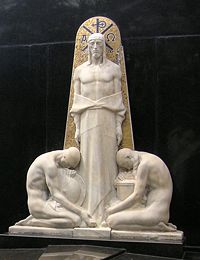
Christ as Alpha and Omega, depicted with the Chi-Rho and Alpha-Omega symbols backside his head.
Alpha and Omega (Greek: Αλφα and Ω) is an appellation of God in the Book of Revelation (verses 1:8, 21:6, and 22:13). Its meaning is found in the fact that Blastoff (Α) and Omega (Ω) are respectively the commencement and last letters of the Greek alphabet. Twice when the phrase appears, it is clarified with the additional title "the beginning and the end" (21:six, 22:13).
Some thus see the term "Blastoff and Omega" equally a paraphrase of Isaiah 44:half dozen: "I am the first and I am the terminal; apart from me there is no God." While the context in the Book of Revelation is clearly related to this, Jewish scholarship shows that the Alpha and Omega is also a Hellenized grade of the rabbinical dictum: "The seal of God is Emet (Truth)," the word Emet (אמת) being derived the first, centre, and concluding letters of the Hebrew alphabet.
Contents
- 1 Jewish background
- ii Christian usage
- 2.1 In Christian art
- 3 Notes
- 4 References
- 5 External links
- half dozen Credits
In the early church, the Alpha-and-Omega symbol became Christ'south monogram and is still used in Christian fine art, often in combination with the Greek letters Chi and Rho, the first two letters of the discussion for Christ in Greek. Traditionally, the phrase is used in Christianity equally evidence for Jesus' divinity and unity with God the Father. An alternative interpretation is that Christ, as the "last Adam" (1 Corinthians 15:45), represents the fulfillment of God's platonic relationship with humanity, rather than being God Himself.
Jewish background
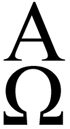
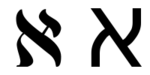
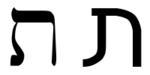
The Hebrew for Truth is Emet. It is equanimous of three letters: Aleph, Mem, and Tav. The Aleph and the Tav are the first and terminal letters of the Hebrew alphabet, equivalent to the Alpha and Omega in the New Testament scripture, which was originally written in Greek. The fact that the discussion Emet begins with the starting time alphabetic character of the alphabet and ends with the last led the ancient Jewish rabbis to see in this discussion a mystical meaning.
God'south accented perfection is expressed in Isaiah 41:iv and 44:vi past the phrase, "I am the first and I am the concluding; apart from me there is no God." The phrase fitly expresses the idea that God is unique and eternal, the showtime and end of all that exists. As the first letter of the alphabet of Emet, Aleph denotes that God is the start of all beings. There was no one before Him of whom He could take received the fullness of truth. The Tav, or last letter, in like fashion, signifies that God is the ultimate existence. At that place is no 1 college than He, and in that location will be no i after Him, since He is eternal. Thus Emet is a sacred discussion expressing that in God, truth dwells absolutely and fully.
In the Talmud (Yoma 69b.; Sanh. 64a.), the following is related: "The men of the great synagogue prayed to God to remove from the earth the Evil Inclination, as the cause of all trouble. Immediately a scroll fell from heaven with the word Truth (Emet) written on it, and a fiery king of beasts immediately came out of the sanctuary. It was the spirit of idolatry leaving the earth." Said the ancient sage Rabbi Hanina, "This fable shows that the seal of God is truth."
Christian usage
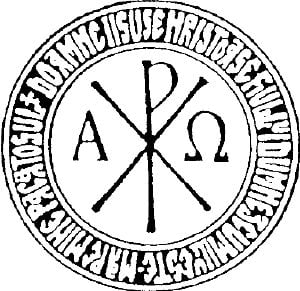
Alpha and Omega with Chi-Rho symbol within a circumvolve containing the words of the "Jesus Prayer" of Eastern Orthodox Hesychast tradition in Romanian.
The tradition of expressing God's eternity by means of the first and concluding letters of the alphabet seems to have been passed down from the synagogue into the early on church building through the Book of Revelation, mostly recognized past biblical scholars as having been written past an author whose showtime language was either Hebrew or Aramaic. In identify of the Aleph and Tav, the Alpha and Omega were substituted in the Greek text. However, the substitution of the Greek letters for those of the Hebrew tongue inevitably caused a portion of the meaning and beauty in this designation of God to be lost, for the Greek messages Alpha and Omega have no relation to the word "Truth." Although Alpha indeed happens to exist the first letter of the Greek word aletheia (truth), Omega is non the concluding letter of the alphabet, as is Tav in the word Emet. In the Greek, the sacred and mystical word "Truth," expressed in Hebrew through the letters Aleph and Tav, had to exist sacrificed.
The Gospel of John, after stating that the "Give-and-take was God," (John 1:one) says, "and the Discussion dwelt among us full of grace and truth." (John ane:14) "Grace" here carries the idea goodness, and the phrase is virtually identical with Exodus 34:6, in which God is described equally "full of goodness and truth." Thus, the writer of this verse expressed the two great divine attributes, Truth and Goodness, assigning them to Christ in all their fullness. What the Hebrew Bible had said of God, John the Evangelist thus says of Christ.
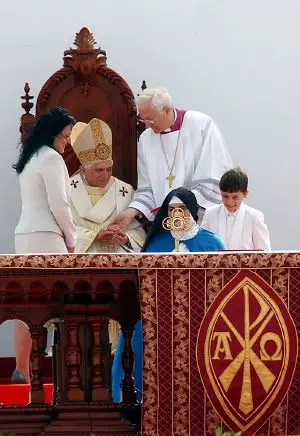
Pope Benedict XVI pictured with an Alpha and Omega symbol
In the Book of Revelation, the "Alpha and the Omega," represents both God (i:eight, 21:6) and Christ (22:13) in unlike verses. This provides testify that the volume's author believed in the divinity of Christ. Yet, this statement has been weakened by textual criticism, which reveals that the most direct reference to Jesus as the Alpha-Omega is not found in some of the earlier and best manuscripts. In traditional renderings of Revelation i:11, it is the glorified Jesus who states: "I am Alpha and Omega, the first and the concluding." However, the occurrence in 1:xi is not plant in some of the oldest Greek manuscripts, including the Alexandrine, Sinaitic, and Codex Ephraemi rescriptus. There poesy is, therefore, believed by almost disquisitional scholars to be spurious and is omitted in many mod translations.[1]
An alternative interpretation of Jesus as the Alpha and Omega is that he represents the fulfillment of God's original platonic for the human relationship between humans and God, rather that being identical with God the Father.
In Christian art
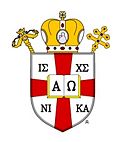
Crest of the Archdiocese of Presov, Slovakia
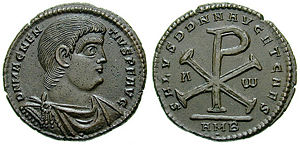
Coin of the Emperor Magnentius, with an Alpha-Omega symbol on the reverse.
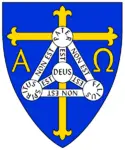
The coat of artillery of the Anglican diocese of Trinidad
In early on Christianity, the Alpha and Omega were oft used as the monogram of Christ. These letters thus became Jesus' crest. The Alpha-Omega symbol was often written under the arms of the cross within a circle or triangle. In after centuries the cross took the form of the Chi-Rho, derived from the first two letters of "Christ" in Greek. Ofttimes the Alpha is found on the correct and the Omega on the left, to indicate that in Christ the beginning and the stop are joined into one. This crest is found on the coins of the emperors Constans, Constantius, and Magnentius. Since Constantius was an Arian and thus a "heretic," this tells us that the symbol was not express to "orthodox" use.
Wealthier early Christians sometimes had the two letters engraved on their signet rings, confirming the Jewish concept (whether consciously or non) of the Truth (which the Christians believed to be incarnate in Jesus) as the "seal of God." Sometimes the Alpha and the Omega are written in the nimbus, or halo, of Jesus as the Lamb of Revelation. Examples of the Alpha and Omega in Christian art include the paintings in the catacombs of Peter and Marcellinus in the third century, as well equally the frescoes and mosaics of several ancient churches, including the chapel of Saint Felicitas and Saint Mark's church in Rome, and the mosaics of Ravenna.
In the course of time, the Alpha and Omega ceased to be used every bit the monogram of Christ for church building paintings and ornaments in Cosmic tradition, although in contempo years information technology has begun to reappear. It is likewise used in Orthodox iconography and has besides found popularity in Anglican and other Protestant traditions. The symbol tin can often be plant on many Christian tombstones.
More than recently, the Blastoff and Omega has been used as a logo on Christian tee-shirts and baseball caps, and has also been adopted by diverse mystical and neo-pagan traditions, symbolizing the unity betwixt God and humans. Tattoo artists often include the symbol in their repertoires, and it has too been used as the logo for various businesses and the title of several rock and ringlet albums and bands.
Notes
- ↑ Young (1977), 179.
References
ISBN links support NWE through referral fees
- Barclay, William. Jesus Equally They Saw Him; New Testament Interpretations of Jesus. New York: Harper & Row, 1962. OCLC 1235361
- J. Paul Getty Museum. Blastoff and Omega: Visions of the Millennium. Los Angeles, Calif: J. Paul Getty Museum, 1999. ISBN 9780892365760
- Jennings, Samuel W. Alpha and Omega: Studies in the Book of Revelation. Greenville, S.C.: Administrator, 1996. ISBN 9781898787778
- Jenson, Robert West. Alpha and Omega; a Study in the Theology of Karl Barth. New York: Nelson, 1963. OCLC 1424755
- Jevtic, Atanasije. Christ, the Alpha and Omega. Alhambra, Calif: Serbian Orthodox Diocese of Western America, 2007. ISBN 9780971950528
- Immature, Robert. Concise Commentary on the Holy Bible: Being a Companion to the New Translation of the One-time and New Covenants. Thousand Rapids: Baker Volume House, 1977. OCLC 5975522
External links
All links retrieved May 17, 2021.
- Blastoff and Omega (in Scripture) Catholic Encyclopedia
- Alpha and Omega Jewish Encyclopedia
Credits
New Earth Encyclopedia writers and editors rewrote and completed the Wikipedia commodity in accord with New Globe Encyclopedia standards. This article abides past terms of the Artistic Commons CC-past-sa 3.0 License (CC-past-sa), which may be used and disseminated with proper attribution. Credit is due under the terms of this license that can reference both the New World Encyclopedia contributors and the selfless volunteer contributors of the Wikimedia Foundation. To cite this commodity click here for a list of acceptable citing formats.The history of earlier contributions by wikipedians is accessible to researchers here:
- Alpha_and_Omega history
The history of this article since it was imported to New World Encyclopedia:
- History of "Alpha and Omega"
Notation: Some restrictions may apply to use of individual images which are separately licensed.
Source: https://www.newworldencyclopedia.org/entry/Alpha_and_Omega
0 Response to "Alpha Is to Omega as First Is to What"
Post a Comment